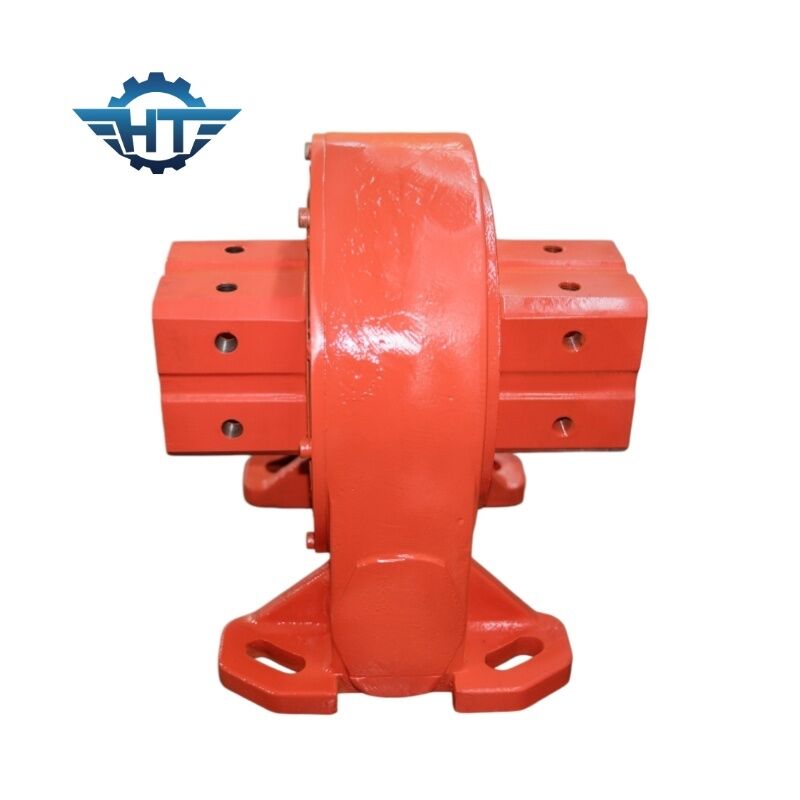


|
|
| Brand Name: | HangTuo |
| Model Number: | VE7" |
| MOQ: | 1 piece |
| Price: | USD 280~504 / pc |
| Delivery Time: | 15~45 days |
| Payment Terms: | L/C, T/T, Western Union |
Self-Locking Worm Gear Slewing Drive for Solar & Industrial Equipment
Description
A worm gear slewing drive is a compact rotary transmission solution designed to provide controlled rotation, high torque output, and reliable load support in a wide range of mechanical systems. It integrates a slewing bearing, worm gear mechanism, housing, bearings, bolts, and other mechanical components into one compact drive unit.
With its high torque capacity, self-locking capability, compact structure, and precise positioning, the worm gear slewing drive is particularly suitable for applications that require controlled rotary movement and stable load holding.
For solar tracking applications, the slewing drive can be combined with a DC planetary geared motor or AC geared motor to provide reliable azimuth or elevation movement. In construction and industrial machinery, it can also be driven by a hydraulic motor for high-load rotary applications.
The worm gear mechanism transfers motor or hydraulic power to the slewing ring, converting input rotation into controlled rotary movement. The worm gear transmission provides a high reduction ratio within a relatively compact housing.
One of the key advantages is its self-locking characteristic. When properly selected for the application, the drive can resist reverse rotation caused by external loads, helping maintain the required position when the motor is not operating.
This makes worm gear slew drives suitable for equipment exposed to changing loads, vibration, wind forces, or positioning requirements.
Parameters of VE Model Slewing Drives
|
Model |
Ratio |
Rated Output Torque(N.m) |
Tilting Torque(N.m) |
Holding Torque(N.m) |
Axial Load(kN) |
Radial Load(kN) |
Efficiency |
Precision(°) |
Self-locking |
Weight(kg) |
|
3" |
31:1 |
600 |
1500 |
1800 |
22 |
15 |
40% |
≤0.1 |
Yes |
12 |
|
5" |
37:1 |
800 |
5000 |
9200 |
16 |
27 |
40% |
≤0.1 |
Yes |
18 |
|
7" |
57:1 |
1750 |
7000 |
13200 |
34 |
58 |
40% |
≤0.1 |
Yes |
32 |
|
8" |
51:1 |
2250 |
11200 |
20400 |
50 |
80 |
40% |
≤0.1 |
Yes |
28 |
|
9" |
61:1 |
2250 |
16000 |
30800 |
60 |
130 |
40% |
≤0.1 |
Yes |
52 |
|
12" |
78:1 |
4300 |
25000 |
40560 |
77 |
190 |
40% |
≤0.1 |
Yes |
65 |
|
14" |
85:1 |
5600 |
48000 |
44200 |
110 |
230 |
40% |
≤0.1 |
Yes |
88 |
|
17" |
102:1 |
6750 |
67000 |
53040 |
142 |
390 |
40% |
≤0.1 |
Yes |
135 |
|
21" |
125:1 |
16000 |
89000 |
65000 |
337 |
640 |
40% |
≤0.1 |
Yes |
192 |
|
25" |
150:1 |
21450 |
112000 |
89000 |
476 |
950 |
40% |
≤0.1 |
Yes |
251 |
Key Features of the VE Worm Gear Slewing Drive
1. High Torque and Load Capacity
The VE series is designed to transmit high output torque while supporting significant axial and radial loads. Different drive sizes allow engineers to select a suitable configuration according to the required torque, overturning moment, and structural loads.
2. Self-Locking Worm Gear Design
The worm gear transmission can provide a self-locking function under appropriate operating conditions. This helps maintain the position of the driven structure without continuous motor power and is especially useful for solar tracking and positioning equipment.
3. Precise Rotary Positioning
With rotational positioning accuracy of up to ≤0.1°, the slewing drive can be used in applications where controlled angular movement is important, including solar trackers, antenna positioning equipment, and industrial rotary machinery.
4. Compact Integrated Construction
The slewing ring, worm gear mechanism, housing, bearings, and mounting components are integrated into a compact drive assembly. This design simplifies installation and can reduce the space required for the rotary transmission system.
5. Sealed and Corrosion-Resistant Design
The enclosed housing helps protect internal transmission components from dust, moisture, and other environmental contaminants. The drive can be configured for outdoor applications where environmental protection and long-term mechanical reliability are required.
6. Multiple Drive Configurations
Depending on the application, the slewing drive can be supplied with different drive solutions, including DC geared motors, AC geared motors, and hydraulic motors. This provides flexibility for solar tracking systems, mobile machinery, and industrial equipment.
Worm Gear Slewing Drive for Solar Tracking Systems
Solar tracking is one of the most widely used applications for worm gear slew drives. A solar tracker slew drivecontrols the angular position of photovoltaic modules so that the panels can follow the movement of the sun throughout the day.
The appropriate slew drive size depends on more than the panel area alone. Important selection factors include:
Total photovoltaic module area
Tracker structure weight
Number and arrangement of modules
Center-of-gravity offset
Wind load and survival wind speed
Required tracking accuracy
Operating speed
Required holding torque
Installation orientation
Local environmental conditions
As a general reference, the following solar panel areas may be considered for preliminary selection:
|
Slewing Drive Size |
Typical Reference Solar Panel Area |
|---|---|
|
3" |
10 m² |
| 5“ | 20 m² |
|
7" |
30 m² |
|
9" |
40 m² |
|
12" |
50 m² |
|
14" |
60 m² |
These values are for preliminary reference only. Final solar tracker slew drive selection should be based on the complete mechanical loading conditions rather than panel area alone.
In addition to photovoltaic tracking systems, worm gear slewing drives are widely applicable to equipment requiring controlled rotary motion and high load capacity.
Typical applications include:
Solar tracking systems
Wind power equipment
Satellite and antenna positioning systems
Truck cranes and lifting equipment
Aerial work platforms
Construction machinery
Port and marine equipment
Mining machinery
Metallurgical equipment
Steel production equipment
Agricultural machinery
Wastewater and sewage treatment equipment
Material handling and rotary positioning equipment
For hydraulic applications, the slewing drive can be paired with a hydraulic motor to create a compact hydraulic slewing drive system for heavy-duty machinery.
Compared with conventional rotary transmission arrangements, an integrated slewing drive provides the advantages of high torque transmission, compact installation, controlled rotation, load holding, and simplified system integration.
For solar tracker manufacturers and equipment integrators, the VE series offers multiple sizes and gear ratios to accommodate different tracker configurations and load requirements. The drive can also be customized with suitable motors, mounting interfaces, and other configurations according to project requirements.
Selecting a slewing drive should be based on the actual application rather than relying only on the drive diameter or solar panel area. Our engineering team can evaluate the required output torque, tilting moment, holding torque, axial load, radial load, rotation speed, and environmental conditions to recommend a suitable model.
For solar tracking projects, please provide the panel quantity and dimensions, tracker structure size and weight, center of gravity, wind conditions, and required tracking angle. This information allows the slewing drive to be selected more accurately for the complete tracking structure.


 english
 français
 Deutsch
 Italiano
 Русский
 Español
 português
 Nederlandse
 ελληνικά
 日本語
日本語
 한국
한국
 العربية
 हिन्दी
 Türkçe
 indonesia
 tiếng Việt
 ไทย
ไทย
 বাংলা
বাংলা
 فارسی
فارسی
 polski